Posted by James (admin) on September 11th, 2010
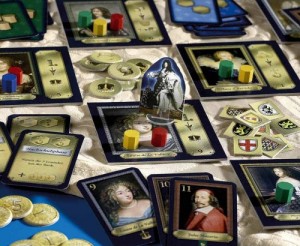 Louis XIV is mostly a worker placement game but it’s quite unusual. First of all, there’s no board; instead, there are 12 mini-boards laid out corner-to-corner in a square grid – this makes it easy to flip over any of the mini-boards but it also leaves spaces where various tokens get placed too. Over 4 rounds, players try to earn as many victory points as possible. Players can earn many VPs by fulfilling their mission cards which are completed by collecting the power chips shown on each card. There are 4 types of power chip as well as one type that counts as any type.
Each round, players receive 5 cards – each card corresponds to one of the 12 mini-boards. Each turn, players can play one of their cards and place up to 3 of their cubes (workers) from their supply onto the mini-board that matches their card. Also, they can move any of the newly placed cubes onto an adjoining mini-board so long as they leave at least one cube behind and do not spread in two different directions at once from the same mini-board. As players only have a limited amount of cubes, they can use their turn to add some cubes to their supply instead of placing. Players discard the last card left in their hand so usually get 4 turns. Read the rest of this entry »
Tags: board game news, Board Games, board gaming, Louis XIV
Posted in Board Game Review, Board Games, Louis XIV | No Comments »
Posted by James (admin) on September 11th, 2010
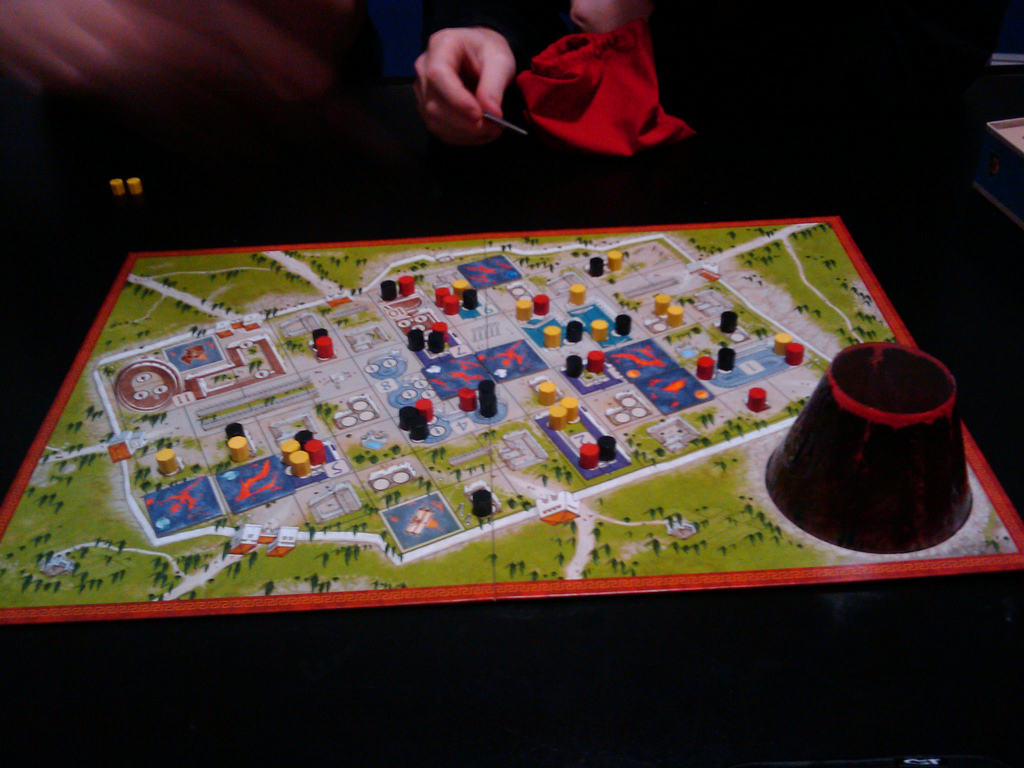
 The Downfall of Pompeii is a light and fast game where players place their people in the buildings of Pompeii and then score points for each one that escapes the city after the volcano erupts. In the first phase of the game, players take turns playing building cards to place their people in the building that matches their card. Each building has a fixed number of spaces for people and, if a building is full, then the player can place their people in any building with spaces. When the AD79 card is drawn, the placement gets faster because if a person is placed in a building that already has occupants, the player adds that many extra people elsewhere on the board too. During this time, a player may draw an Omen card which means they get to throw one of their opponent’s people into the card volcano. Read the rest of this entry »
Tags: board game news, Board Games, board gaming, The Downfall of Pompeii
Posted in Board Game Review, Board Games, Downfall of Pompeii | No Comments »
Posted by James (admin) on September 9th, 2010
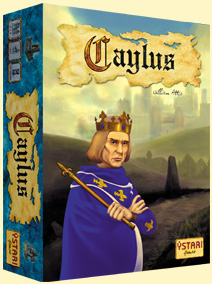 I had played Caylus: Magna Carta before (the smaller, card-based version of Caylus) but not the original big game so I was looking forwards to playing this.
During the game, players place their workers on various buildings so they can generate resources and cash which they can then use to build further buildings and generate victory points. First, players take turns placing their workers on the available buildings. Only one player can use each building during a round, so timing your placement of your workers can be agonising (in a good way) because you always want to place your workers in multiple places at once (always a good sign in a worker placement game) before someone else does. When all players have passed, the buildings get resolved in order (moving along the road that leads out of the castle). Some buildings generate resources (food, wood, stone, cloth, gold), some generate cash, and some have special effects like allowing a player to build a new building, changing the turn order, allowing a player to buy a resource for cash, trade gold for victory points, and so on. Read the rest of this entry »
Tags: board game news, Board Games, board gaming, Caylus
Posted in Board Game Review, Board Games, Caylus | 2 Comments »
Posted by James (admin) on September 8th, 2010
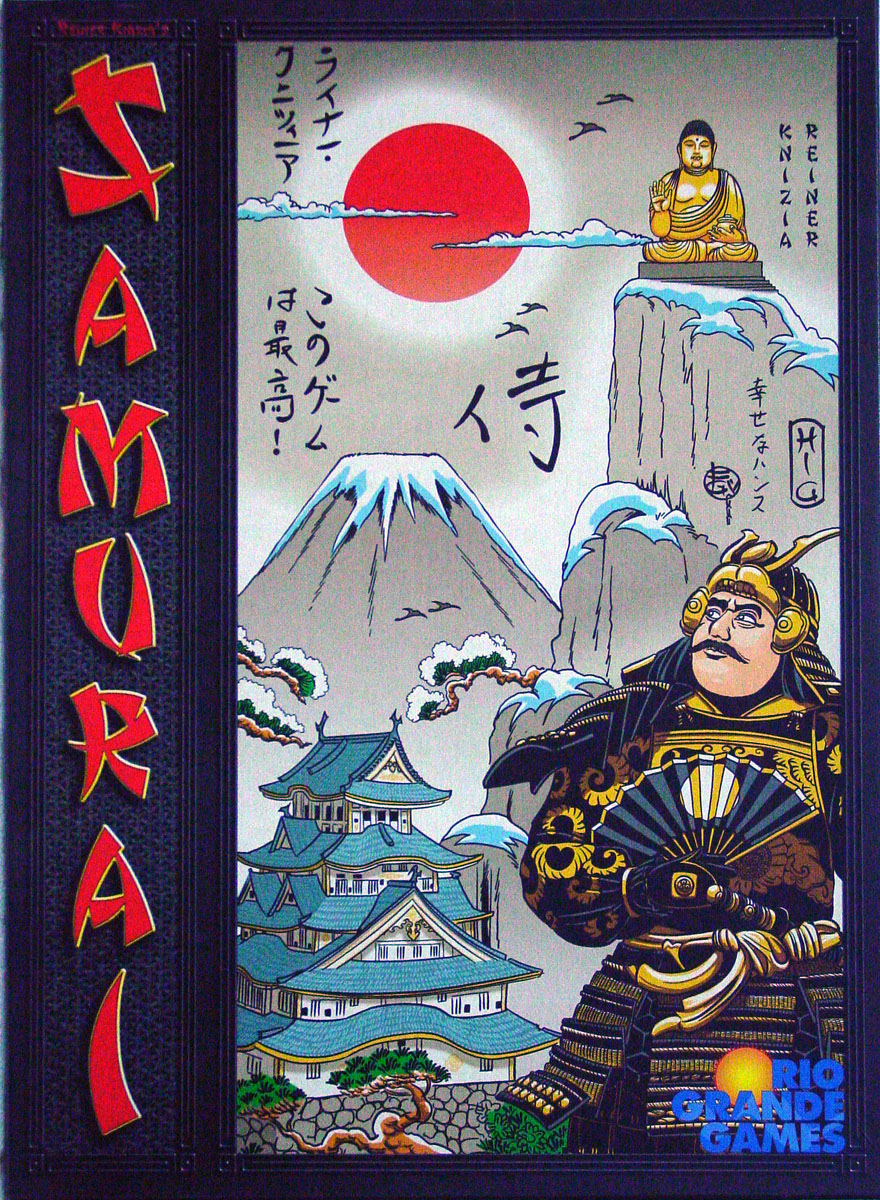
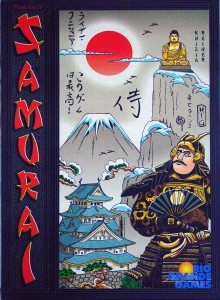 In Reiner Knizia’s classic game, players take turns placing hexagonal tiles from their hand onto a map of Japan where some of the hexes (villages, towns and cities) contain one or more of the 3 types of markers (helmets, rice fields, buddhas). When a location containing one or more markers is surrounded by tiles (sea areas don’t need to contain tiles), the tile strengths of each player are added up and the player with the greatest relevant strength wins the relevant marker. Many tiles’ strength only counts towards capturing one of the 3 types of markers but a few (like the Samurai) count towards all types.
For example, a hex on the coast containing a Buddha maker has the following tiles around it: Red 2 buddha, Red 2 samurai, Yellow 4 helmet, Yellow 1 Samurai, Green 3 buddha. As the other hex around this location is a sea hex, the village is surrounded. In this case, Red wins the Buddha because they have a total of 4 towards capturing buddhas. Green’s total of 3 isn’t enough, and neither is Yellow’s total of 1 because their helmet tiles doesn’t count towards capturing buddhas.
Read the rest of this entry »
Tags: board game news, Board Games, board gaming, Knizia, Samurai
Posted in Board Game Review, Board Games, Samurai | 1 Comment »
Posted by James (admin) on September 8th, 2010
Occasionally, a friend of mine runs an all-day boardgames tournament at the games shop (Eclectic Games) in Reading (UK) where anyone can turn up and play. The day consists of around 5 or 6 games each played with 3 or 4 players and the people in each group changes every game so you get to play with most people present. Saturday was the fourth of these tournament days (called BADGER which stands for Berskhire All-Day Gaming Extravaganza in Reading) and I got to play games that were mostly new to me.
The games I played were: Read the rest of this entry »
Tags: BADGER, board game news, Board Games, board gaming, Caylus, Eclectic Games, Il Principe, Louis XIV, Samurai, The Downfall of Pompeii
Posted in Board Games, Caylus, Downfall of Pompeii, Games Session, Il Principe, Louis XIV, Samurai | No Comments »
Posted by James (admin) on September 1st, 2010
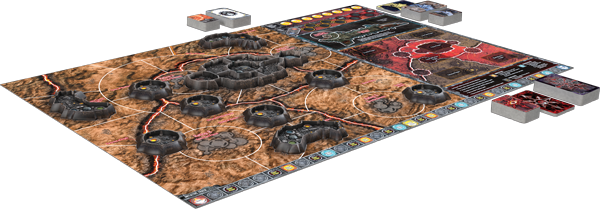
 Horus Heresy is FantasyFlight Game’s new version of the 1993 game set in the Warhammer 40k universe where the two players fight out the pivotal moment where Warmaster Horus turns traitor and tries to destroy the Emperor in an epic battle raging around the Imperial Palace and on the traitor’s flagship in orbit.
This isn’t a full review because Horus Heresy is a big game and, after a couple of plays, I’m not sure I’ve seen enough of it yet to have a final opinion but I do have some initial thoughts and concerns. (Please note that I haven’t played the original game so this just covers the new version.)
THE GAME
The large game board shows the landscape around the Imperial Palace, the Traitor’s flagship, and a smaller strategic map where order cards can be laid. The landscape section has several holes cut in the board to allow plastic formed craters and fortifications to stick through. These look great and make it really easy to see where the fortified areas are. The figures and components look great as you’d expect from a FFG game. Read the rest of this entry »
Tags: Board Games, board gaming, horus heresy
Posted in Board Games, Horus Heresy, Thoughts On | 2 Comments »
Posted by James (admin) on August 29th, 2010
After posting my Axis & Allies: Guadalcanal, someone let me know that Hasbro issued some errata and the reinforcement points should have been twice as many as stated in the printed rules, i.e. 10 + 4 per island. That would have made a big difference as we could have bought a lot more reinforcements during the game. Hasbro’s web site says you can play it either way (with the double reinforcement points or without) so my review is of the game without that ammended rule as we played it using the rules as stated in the box. Please keep this in mind when you read the review.
Now I know the errata says we should have received double the amount of reinforcement points that we did, I can see that this would have made a big difference as we could have reinforced properly and our forces would have diminished much less. I’m not sure it would solve all the issues in the game and I’m not convinced it would mean it would be better than its siblings (D-Day or Battle of the Bulge); however, I think it would have been better than it was and could make a bit more sense to the ratio of pieces included in the box. I’ll write a revised review when I play it again using the proper rules, although that may not be for sometime. Such a shame a game could have such a major error in the rules.
I really should check the Hasbro/Wizards/Avalon Hill web site before playing their games from now on – the original version of ‘Betrayal at the House on the Hill’ I have (and played) had so many errors and incomplete rules in it that the errata they released was about the same size as the rules!
Also, thanks to the person who let me know about the rule error too.
Tags: Board Games, board gaming
Posted in Axis & Allies: Guadalcanal, Board Games | No Comments »
Posted by James (admin) on August 28th, 2010
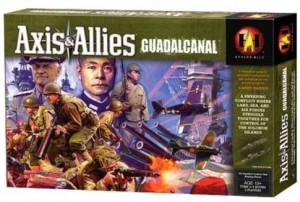 [Note: After posting this review, someone let me know that Hasbro issued some errata and the reinforcement points should have been twice as many, i.e. 10 + 4 per island. That would have made a big difference as we could have bought a lot more reinforcements. Hasbro’s web site says you can play it either way (with double reinforcement points or without) so this is a review of the game without that ammended rule as we played it using the rules as stated in the box. Please keep this in mind when you read the review and I’ll comment more on it at the end.]
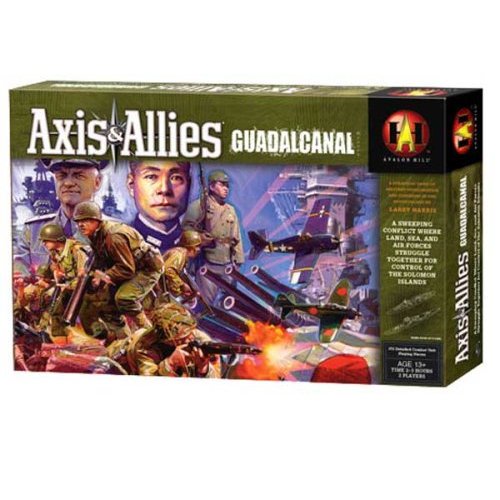
Axis & Allies: Guadalcanal is one of the three 2-player Axis & Allies games – the others being D-Day and Battle of the Bulge. Each game has completely different rules to the others and all have different rules compared to the main Axis & Allies game too. Earlier this year, my friend Matt and I decided to start playing some games that are connected to their anniversaries so we played A&A: D-Day on June 6th. As I like A&A: D-Day and Battle of the Bulge, I picked up a second-hand copy of Guadalcanal to play in August (anniversary of the start of the Guadalcanal conflict).
The Guadalcanal conflict was a series of battles during World War II which lasted many months where both sides fought over a group of tactically important islands in the Pacific. So, the board shows 6 main islands (land zones) and the sea around them is segmented into zones, plus players have a home base zone each too. Both players have land forces (infantry, artillery, anti-air), air forces (fighters, bombers) and sea forces (transports, destroyers, cruisers, submarines, aircraft carriers, battleships). The islands have spaces on them where one or two airfields can be built. Read the rest of this entry »
Tags: board game news, Board Games, board gaming
Posted in Axis & Allies: Guadalcanal, Board Game Review, Board Games | 6 Comments »
Posted by James (admin) on August 27th, 2010
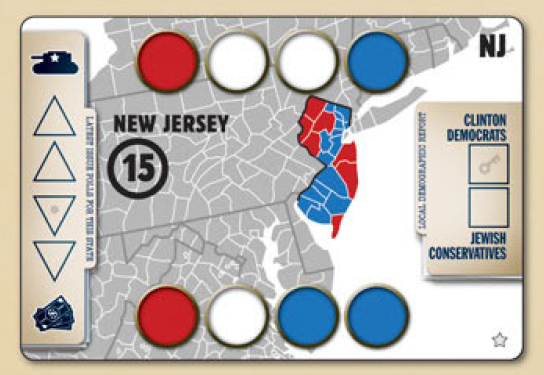
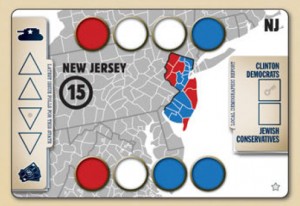 Campaign Manager 2008 is a card-driven game recreating the Presidential Election between Obama and McCain. The designers of the game are well-known for Twilight Struggle and 1960: Making of the President – both are card driven strategy games and Twilight Struggle is ranked the number 3 best board game of all – so the game was highly anticipated.
The game primarily consists of 45 cards for each player, a deck of Breaking News cards, a mini-board for each state. Players aim to win the electoral votes of each state and be the first player to gain 270+ votes. During the game, 4 states boards are laid between the players which are the ones the players are currently campaigning (fighting) over to win. Each state has a track showing whether economy or defence is currently the important issue to its voters, and each state has two demographic groups printed on them with a marker showing which is currently the most influential group in that state. Read the rest of this entry »
Tags: board game news, Board Games, Spiel 09
Posted in Board Game Review, Board Games, Campaign Manager 2008 | No Comments »
Posted by James (admin) on August 26th, 2010
Fifty-seven days to Spiel in Essen and my list of games to check out (ranging from take a look to definitely pre-order) is already up to 44 games. Two more games definitely stirring my interest are Dakota and Olympus.
Dakota is a game of settlers and natives in the American West. It caught my attention because players can be settlers or natives in any mix and the the two sides play differently on the same board. Also, players on the same side may be allied but not a team. Bruno Faidutti’s write-up was very complimentary and being called the tensest nastiest game just intrigues me more. The image of the game from Spiel 2009 makes it look quite complex but I’m hoping the 60-90 minutes playing time means it’s not too fiddly as that would limit the people I could play it with.
Olympus is designed by the same guys that created Kingsburg so, for me, that definitely makes it worth a look. I own the board game of Kingsburg and I played the PC version against the AI a lot so I know it well and like the balance and choices the game offered. Rather than dice-rolling, Olympus is priest (worker) placement game with difficult choices each turn and no luck involved. Sounds good, and as it’s from these designers, I’ll definitely check it out.
James.
Tags: board game news, Board Games, board gaming, Essen, Spiel 2010
Posted in Board Games, Dakota, Essen Spiel 10, Olympus, On the Radar | No Comments »


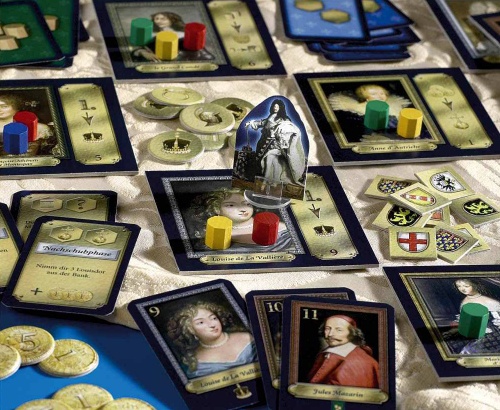 Louis XIV is mostly a worker placement game but it’s quite unusual. First of all, there’s no board; instead, there are 12 mini-boards laid out corner-to-corner in a square grid – this makes it easy to flip over any of the mini-boards but it also leaves spaces where various tokens get placed too. Over 4 rounds, players try to earn as many victory points as possible. Players can earn many VPs by fulfilling their mission cards which are completed by collecting the power chips shown on each card. There are 4 types of power chip as well as one type that counts as any type.